
Wet Wipes Machine Selection: Line Architecture, Packing Formats, and Verification
A technical buyer's guide to wet wipes machine architecture: how folding, wetting, cutting, and packing stages interact, how to match a line to sachet or mini formats, and what to inspect before purchase.
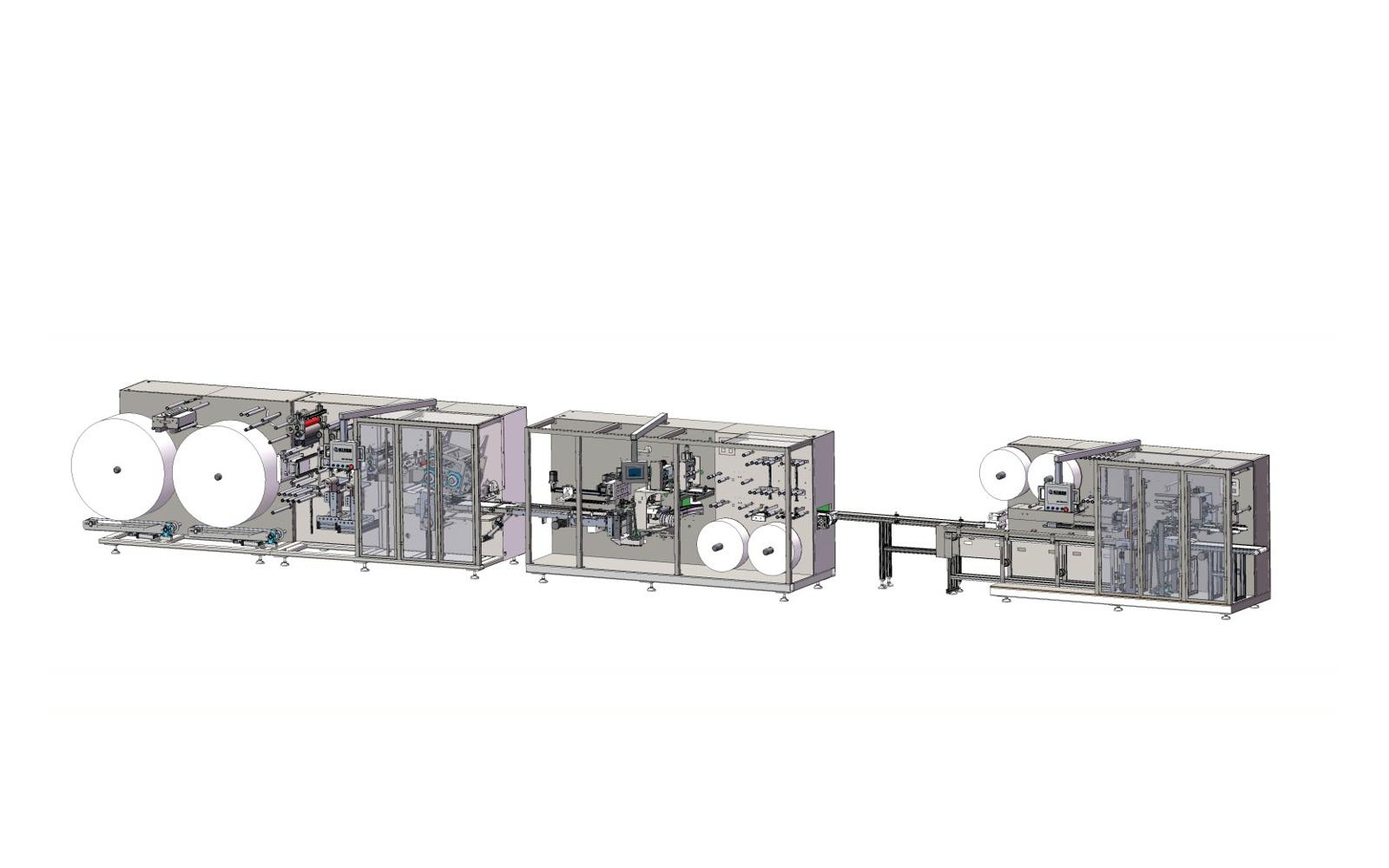
What a wet wipes machine actually controls
A wet wipes machine is a synchronized web-handling system: it unwinds nonwoven roll stock, folds it, applies liquid, cuts it into wipe units, and packs those units into sealed sachets or grouped packs. The machine's value is not any single station but the stability of the handoff between stations. Tension errors at the unwind become fold misalignment at the cutter; liquid application drift becomes seal contamination at the packer. Buyers who evaluate stations in isolation often discover these couplings only after installation.
The practical question is therefore not "how fast is the machine" but "which architecture matches my pack format, and how will I verify that the architecture holds tolerance at my target speed." This guide covers the main line types, the parameters that determine fit, and the inspection steps that separate a demonstrable line from a specification sheet.
Line architecture: four stages that must agree
Most wet wipes production lines follow the same sequence, whether they produce single sachets or grouped mini packs:
- Roll handling and splicing. Multi-shaft feeding with automatic splicing and tension control allows roll changes without stopping the downstream process. The number of shafts and the splicing mechanism determine how much operator intervention the line needs.
- Folding. The fold pattern (for example, single-fold or multi-fold stacks) sets the wipe's final dimensions and how it presents when the sachet is opened. Dual-channel folding sections run two webs in parallel to raise output within a compact footprint.
- Liquid application. The wetting station must deliver a consistent dose per wipe. Dose consistency depends on web speed, absorbency of the nonwoven, and the control method for the liquid feed.
- Cutting and primary packing. Synchronized cutting separates wipes to length; the primary packer forms and seals the sachet. Cut-to-seal timing is where most format changes force mechanical or servo adjustments.
Supplied product documentation describes these stages in specific configurations. The LZC-SCM400 high-speed single wet wipes line is documented as bringing multi-shaft roll handling, folding and liquid application, synchronized cutting, and single-sachet primary packing into one production arrangement. The LZC-SCM400TG adds a connected secondary packaging section for grouped finished packs, covering roll handling through grouped-pack handling. The LZC-LPDT20 dual-channel super mini line combines web feeding, folding, liquid application, cutting, and pack grouping into one compact path with a simple 4/6/8/10-in-one grouped-pack configuration.
Matching line type to pack format
Pack format is the first filter, because it determines whether you need a single-sachet machine, a mini wet wipes packing line, or a line with secondary packing. The table below maps the supplied configurations to their documented formats. It is a scoping aid, not a performance comparison; speed and yield figures must come from the supplier's verified data for your specific material and pack.
| Line configuration | Primary output | Grouping / secondary stage | Typical fit |
|---|---|---|---|
| High-speed single wet wipes line (LZC-SCM400) | Individual wet wipes sachets | None documented | Personal care, household, hospitality and travel sachets sold singly |
| High-speed single wet wipes production and secondary packing line (LZC-SCM400TG) | Single-wipe sachets | Connected secondary packaging for grouped packs | Hospitality and travel wipes sold in multi-sachet groups |
| Dual-channel super mini wet wipes line (LZC-LPDT20) | Super mini wet wipes sachets | Simple 4/6/8/10-in-one grouped-pack configuration | Compact-footprint production of mini sachets in bundles |
Two decision rules follow from this table. First, if your product is sold as a single sachet, a single-sachet line without secondary packing is the simpler architecture; adding grouping later means adding a separate packing stage or choosing a connected line from the start. Second, if your market expects four-, six-, eight-, or ten-pack bundles, the grouping configuration is not an accessory—it is part of the line's output definition, and its changeover flexibility should be demonstrated, not assumed.
Technical parameters that decide fit
Once the format is fixed, the evaluation shifts to parameters that interact with your material and pack design. Ask for each of these in writing, tied to a specific nonwoven grade and liquid formulation.
Web width and fold geometry
Web width constrains the maximum unfolded wipe dimension; fold geometry determines the folded footprint that must fit the sachet. A line specified for one fold pattern may need new folding plates or servo profiles for another. Confirm the fold patterns the machine can run and the mechanical change required between them.
Tension control and splicing
Automatic splicing and tension control are documented features on the supplied single-wipe and super mini lines. The buyer-relevant question is the tension window: at what range of web tensions does the line hold fold alignment, and what happens to cut registration when tension drifts? Request a demonstration that includes a roll splice under production speed, because splice transients are a common source of misaligned cuts.
Liquid dose consistency
Dose per wipe is a function of web speed, nonwoven absorbency, and liquid feed control. Specify the target dose range and tolerance for your formulation, and ask how the machine maintains it across speed changes. Liquid viscosity and surfactant content affect wetting behavior; a line tuned for one formulation may need re-tuning for another.
Cut-to-seal synchronization
Synchronized cutting is documented on the supplied lines. In practice, the seal station must close on a wipe that is positioned within the sachet's seal zone. Ask for the registration tolerance and how it is measured—for example, whether the line uses registration marks or servo position feedback—and request a sample run at the low and high ends of your target speed range.
Seal integrity
Seal quality depends on the packaging film, seal temperature, pressure, and dwell time, and on keeping liquid away from the seal zone. Ask which film structures the machine has been run with and what seal-integrity check the supplier recommends. A dye-penetration or burst test on production samples is a practical acceptance criterion; the specific test method should be agreed with the supplier and, where applicable, aligned with the standards your market requires.
Common failure modes and how to detect them
Most wet wipes line problems trace back to a small set of interactions. The diagnostic value is in knowing where to look during a factory acceptance test rather than after commissioning.
- Fold misalignment after splicing. Symptom: cut wipes with uneven edges or exposed fold. Detection: inspect wipes immediately after a splice at production speed, not just at startup.
- Liquid migration into the seal zone. Symptom: weak or leaking seals, especially on the trailing edge. Detection: seal-integrity testing on samples taken at the highest speed, when liquid dwell time is shortest.
- Cut registration drift. Symptom: wipes progressively offset within the sachet. Detection: measure registration on a consecutive run of packs, not isolated samples.
- Grouping count errors. Symptom: bundles with wrong sachet counts. Detection: count verification on a continuous run of bundles, including after a format change.
- Web breaks at high speed. Symptom: stops concentrated at the unwind or cutter. Detection: log stop reasons and locations during the acceptance run.
Factory acceptance test: what to specify and record
A wet wipes machine is difficult to evaluate from a catalogue because performance is material-dependent. The acceptance test is where the buyer converts claims into evidence. Specify the following before the test:
- The nonwoven grade, basis weight, and roll width to be used.
- The liquid formulation, target dose per wipe, and tolerance.
- The packaging film structure and sachet dimensions.
- The speed range to be demonstrated and the duration of the continuous run.
- The sampling plan: how many sachets or bundles per interval, and which measurements are taken on each.
- The acceptance criteria for fold alignment, dose, seal integrity, cut registration, and count accuracy.
Record stop events with reason and location, and keep the samples. A line that meets criteria only at reduced speed has told you something useful: the gap between demonstrated and target speed is the commissioning risk you are accepting.
Scope, utilities, and site readiness
Line selection also depends on what the machine needs from the building. Compressed air quality and pressure, power supply, floor loading, and clearance for roll handling and pack discharge all constrain layout. For a compact dual-channel mini line, the footprint advantage is real but the grouping stage still needs discharge space and operator access. Ask for a layout drawing with utility connection points and confirm it against your actual room, not a nominal dimension.
Operator competence is a related constraint. Multi-shaft feeding and automatic splicing reduce manual intervention, but format changes, film loading, and fault recovery still require trained staff. Ask what training is included and what documentation covers changeover and fault codes.
Limitations to state before you buy
No line is format-agnostic. Changeover between sachet sizes or bundle counts takes time and may require tooling; the supplier should state the changeover steps and the parts involved. Speed ratings are material- and format-dependent and should be treated as targets until demonstrated on your materials. Seal integrity depends on film choice as much as on machine settings, so film and machine should be qualified together. Finally, the supplied documentation describes configurations and process stages; it does not establish regulatory compliance for your market. Confirm applicable requirements for the product category and destination separately.